


Introduction
AI chatbot technology is reshaping how businesses communicate with customers in today’s digital world. From instant replies to automated workflows, chatbots are becoming a powerful tool for improving efficiency and customer experience.
Moreover, businesses no longer need large support teams to handle queries. With the right chatbot setup, companies can deliver fast, accurate, and consistent responses. As a result, both small startups and large enterprises are adopting this technology rapidly.
Table of Contents
1. What is an AI Chatbot?
2. How AI Chatbots Work
3. Key Benefits of AI Chatbot in Business
4. Types of AI Chatbots
5. AI Chatbot Use Cases Across Industries
6. Choosing the Right AI Chatbot Platform
7. Future of AI Chatbot Technology
1. What is an AI Chatbot?
An AI chatbot is a software application that uses artificial intelligence to simulate human-like conversations. It can interact through websites, apps, or messaging platforms.
Unlike traditional chat systems, AI chatbots understand user intent and provide relevant answers. They use technologies like Natural Language Processing (NLP) to interpret queries more accurately.
In simple terms, an AI chatbot works like a virtual assistant that is available 24/7 without breaks.

2. How AI Chatbots Work
AI chatbots operate through a combination of machine learning and data processing. They analyze user input, identify intent, and respond accordingly.
Key Components
- Natural Language Processing (NLP)
- Machine Learning algorithms
- Data training models
- Backend integrations
For example, when a user asks about pricing, the chatbot processes keywords and context before delivering an accurate answer.
Therefore, this system ensures quick and consistent communication without human delay.

3. Key Benefits of AI Chatbot in Business
Using an AI chatbot can significantly improve business performance.
24/7 Availability
Customers expect instant support. Chatbots provide round-the-clock assistance without downtime.
Cost Efficiency
Instead of hiring large teams, businesses can automate repetitive tasks and reduce expenses.
Better Customer Experience
Fast responses improve satisfaction and build trust.
Lead Generation
Chatbots can collect user data and qualify potential customers automatically.
Scalability
Handling thousands of conversations becomes easy without additional resources.

4. Types of AI Chatbots
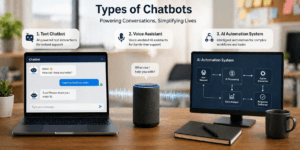
Different businesses require different chatbot solutions. Here are the main types:
| Type of Chatbot | Description | Best Use Case |
|---|---|---|
| Rule-Based Chatbot | Follows fixed rules and scripts | FAQs |
| AI-Powered Chatbot | Uses NLP and machine learning | Advanced support |
| Voice Chatbot | Responds to voice commands | Virtual assistants |
| Hybrid Chatbot | Combines rules and AI | Business automation |
Choosing the right type depends on your business goals and customer needs.
5. AI Chatbot Use Cases Across Industries
AI chatbot applications are expanding rapidly across industries.
E-commerce
Chatbots help customers find products, track orders, and handle returns.
Healthcare
They assist with appointment booking and basic health information.
Education
Students can get instant answers and learning support.
Digital Marketing
Businesses use chatbots to capture leads and automate communication.
For instance, a digital agency can use an AI chatbot to convert website visitors into potential clients instantly.

6. Choosing the Right AI Chatbot Platform
Selecting the right platform is essential for success.
Key Factors
- Ease of use
- Integration capabilities
- Customization options
- Pricing
- AI features
Moreover, beginner-friendly platforms with drag-and-drop builders can help businesses get started quickly.
7. Future of AI Chatbot Technology
The future of AI chatbot technology is promising and innovative.
Emerging Trends
- Voice-based interactions
- Hyper-personalization
- Integration with smart devices
- Emotional intelligence in AI
As technology evolves, chatbots will become more human-like and efficient.
Businesses that adopt early will gain a strong competitive advantage.
Conclusion
AI chatbot solutions are becoming essential for modern businesses. They improve customer support, automate processes, and enhance overall efficiency.
If implemented correctly, an AI chatbot can save time, reduce costs, and increase customer engagement. Therefore, adopting this technology today can help businesses stay ahead in a competitive market.