


Introduction
Artificial intelligence is no longer a futuristic concept—it is a present-day reality shaping how we live, work, and interact. From smartphones to smart homes, AI has seamlessly integrated into our daily routines. Moreover, businesses are leveraging AI to automate tasks, improve decision-making, and enhance customer experiences.
As technology evolves, AI continues to unlock new possibilities. Therefore, understanding its applications, benefits, and challenges is essential for anyone navigating the modern digital world.
Table of Contents
1. What is Artificial Intelligence?
2. Key Types of AI
3. Applications of Artificial Intelligence in Daily Life
4. Role of Artificial Intelligence in Business
5. Benefits and Challenges of Artificial Intelligence
6. Future Trends of Artificial Intelligence
7. How to Start Learning Artificial Intelligence
What is Artificial Intelligence?
Artificial intelligence refers to the simulation of human intelligence in machines. These systems are designed to think, learn, and make decisions similar to humans. In simple terms, AI enables machines to perform tasks that usually require human intelligence, such as problem-solving, speech recognition, and decision-making.
In addition, AI uses technologies like machine learning and deep learning to improve performance over time. For example, recommendation systems on streaming platforms learn your preferences and suggest relevant content.
Key Types of AI
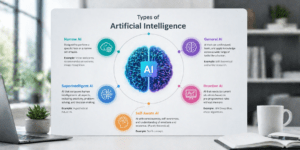
AI can be broadly categorized into three main types:
Narrow AI
This is the most common form of AI today. It is designed for specific tasks, such as voice assistants or recommendation systems.
General AI
This type aims to perform any intellectual task that a human can do. However, it is still under development.
Super AI
A theoretical concept where machines surpass human intelligence. While it sounds exciting, it also raises ethical concerns.
Applications of Artificial Intelligence in Daily Life
AI is deeply embedded in our everyday lives. Many people use AI without even realizing it.
For instance, voice assistants help with tasks like setting reminders or checking the weather. Similarly, navigation apps use AI to provide real-time traffic updates.
Common Uses of AI
- Smart assistants like Alexa and Google Assistant
- Personalized recommendations on shopping and streaming platforms
- Face recognition in smartphones
- Chatbots for customer support
Moreover, AI enhances convenience by saving time and improving efficiency in routine activities.

Role of Artificial Intelligence in Business
Businesses are rapidly adopting AI to stay competitive. It helps organizations streamline operations and make data-driven decisions.
For example, AI-powered tools analyze customer behavior to improve marketing strategies. In addition, automation reduces manual work, allowing employees to focus on more strategic tasks.
Key Business Applications
- Customer service automation through chatbots
- Predictive analytics for better decision-making
- Fraud detection in banking systems
- Supply chain optimization
Therefore, AI is becoming a critical component of modern business strategies.

Benefits and Challenges of Artificial Intelligence
AI offers numerous advantages, but it also comes with certain challenges.
Benefits
- Increased efficiency and productivity
- Reduced human error
- Faster decision-making
- Enhanced customer experiences
Challenges
- Job displacement due to automation
- Data privacy concerns
- High implementation costs
- Ethical issues
Understanding both sides helps in using AI responsibly and effectively.

Artificial Intelligence Comparison Table
| Aspect | Traditional Systems | Artificial Intelligence Systems |
|---|---|---|
| Decision Making | Rule-based | Data-driven learning |
| Adaptability | Low | High |
| Efficiency | Moderate | High |
| Error Handling | Manual correction | Automated learning |
| Scalability | Limited | Highly scalable |
Future Trends of Artificial Intelligence
The future of artificial intelligence looks promising and transformative. Emerging technologies are pushing AI to new heights.
Key Trends
- AI integration with IoT devices
- Growth of autonomous vehicles
- Advanced healthcare diagnostics
- AI-driven content creation
Moreover, AI is expected to become more human-like in understanding emotions and context. This will further improve user experiences across industries.

How to Start Learning Artificial Intelligence
If you want to explore AI, starting with the basics is crucial.
Beginner Steps
- Learn programming languages like Python
- Understand machine learning concepts
- Practice with real-world projects
- Use online platforms and tools
In addition, staying updated with industry trends will help you grow faster in this field.
Conclusion
Artificial intelligence is transforming the world at an unprecedented pace. From simplifying daily tasks to revolutionizing industries, its impact is undeniable. However, balancing innovation with ethical responsibility is essential.
As technology continues to evolve, AI will play an even bigger role in shaping the future. Therefore, embracing AI today can open doors to countless opportunities tomorrow.